



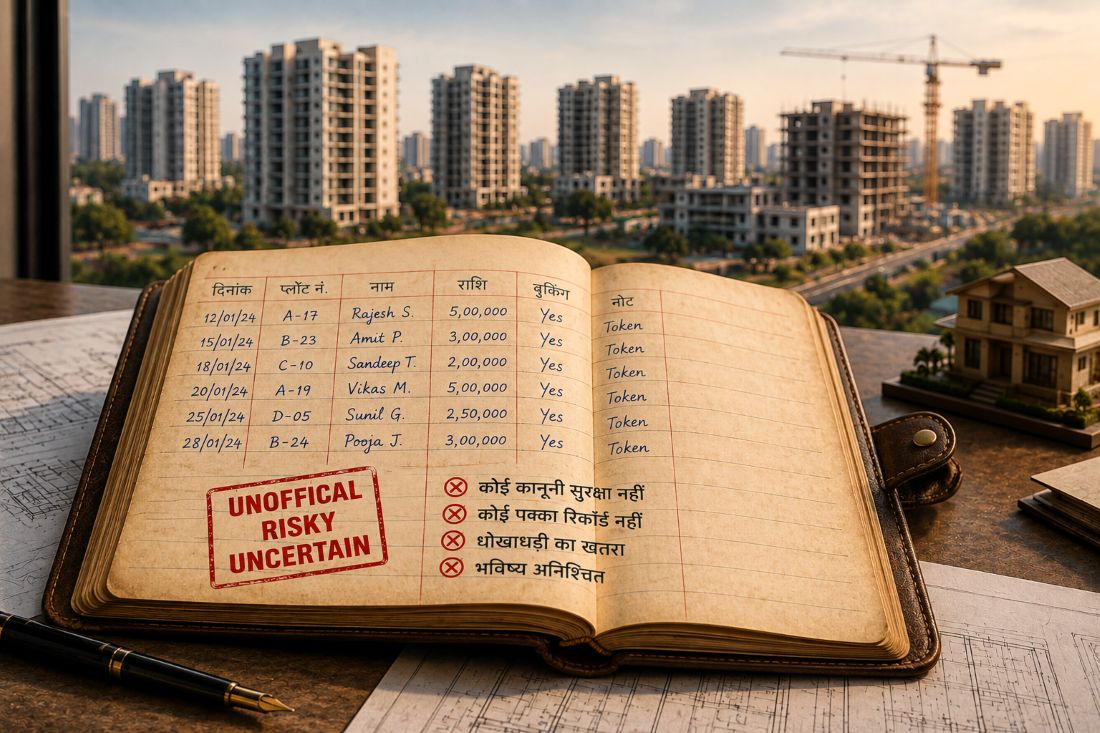
Quick Take: In Indore’s real estate market, the “Diary System” has long been discussed as a way to enter certain properties at an early or lower price often before the complete legal and regulatory process is in place.
For some investors, it looks like an opportunity.
For buyers, however, the bigger question is: Is saving money worth taking on legal and financial uncertainty?
What Is the Diary System?
In simple terms, the term is commonly used for property transactions where a buyer’s booking or investment is recorded through a private document, receipt or diary entry, while formal registration and other legal processes are expected to happen later. This can appear attractive because the entry price may be lower than that of a fully approved and registered property.
But a private record is not the same thing as a registered conveyance of ownership.
Why Do Buyers Enter Such Deals?
There are generally two motivations. Early Investors may expect approvals and development to progress, allowing them to enter at a lower price and benefit from future appreciation.
Budget-Conscious Buyers may see it as a way to access property that would otherwise be beyond their immediate budget.
The attraction is simple:
Lower Entry Price + Expected Future Appreciation
But the risk lies in the second half of that equation “expected.”
Why Would a Developer Use This Model?
From a developer’s perspective, early collections can provide working capital for land development and initial project activity.
That can make the model financially attractive during the early stages of a project.
But the buyer effectively carries significant uncertainty if approvals, land-use permissions or development plans do not progress as expected.
Where the Real Risk Begins?
What happens if:
- Approvals are delayed?
- Land-use permissions change?
- The project faces a legal dispute?
- Development stops?
- The seller refuses to honour the arrangement?
- The property is subsequently claimed by another party?
A buyer who has paid money but does not have a properly registered transaction may face a much more complicated legal and financial situation.
A diary entry, receipt or private agreement should therefore not be treated as equivalent to a registered sale deed.
The Indore Talk Realty Reality Check
The Diary System should not simply be labelled an “opportunity” or “fraud.”
Every transaction has to be evaluated on its specific facts, documentation, approvals and legal structure.
But one principle remains clear:
A lower price does not compensate for an unclear title.
Before investing, buyers should verify:
Land Title
Who legally owns the land?
Land Use & Approvals
Is the proposed development legally permissible?
Project Permissions
What approvals have actually been obtained?
RERA Applicability
Does the project require RERA registration?
Registration
What exactly is being registered and when?
Legal Due Diligence
Has an independent property lawyer verified the documents?
The Bottom Line
Real estate is a long-term investment.
Saving a few lakh rupees at the entry stage can become extremely expensive if the property later gets trapped in legal disputes, approval issues or ownership uncertainty.
Don’t just ask, “Kitne mein mil raha hai?”
Ask:
“Mujhe legally kya mil raha hai?”
Because the safest real estate investment isn’t necessarily the cheapest one.
It is the one where your ownership, documentation and legal rights are clear.
🎥 WATCH THE FULL EPISODE
Can the Diary System actually be an opportunity or is the risk simply too high for an ordinary property buyer?
In Indore Talk Realty NEWSROOM, Vivek breaks down the Diary System, why buyers enter it, how the model works, and the legal and financial risks you need to understand before investing.
▶️ Watch the full episode.